The Wire Harness and Its Critical Tests

The Wire Harness and Its Critical Tests

하네스 내전압검사장비1 horz 1

“With Reliable Wireharness”


Have you ever looked inside a complex electronic device or a car? Beneath the luxurious leather seats or sleek dashboard screens lie clusters of intricately intertwined wires—the wire harness. The wire harness is like the neural network or blood vessels of a machine. It is the most fundamental component that allows equipment to finally function properly as power is delivered and signals flow. Today, before this wire harness is released into the world, I’d like to share the story of the most rigorous and essential processes it must undergo to achieve complete reliability: the continuity test, withstand voltage test, and insulation resistance test.

Why Not a Single Wire Can Be Taken Lightly
A wire harness manufacturing site requires a significant amount of manual labor. This includes cutting cables to exact specifications, stripping insulation, crimping terminals, inserting them into connector housings in the correct sequence, and bundling dozens or even hundreds of these wires into a single unit. Although automation technology has advanced considerably, the delicate array and assembly processes still demand the honed intuition of experienced workers.
However, relying on human hands also means there is always a chance for subtle errors; a single misplaced connector pin or a loosely crimped terminal can instantly render the entire product “defective.” This is precisely why the inspection process is an indispensable part of wire harness manufacturing.
4 horz

🚦The First Test: Continuity Test

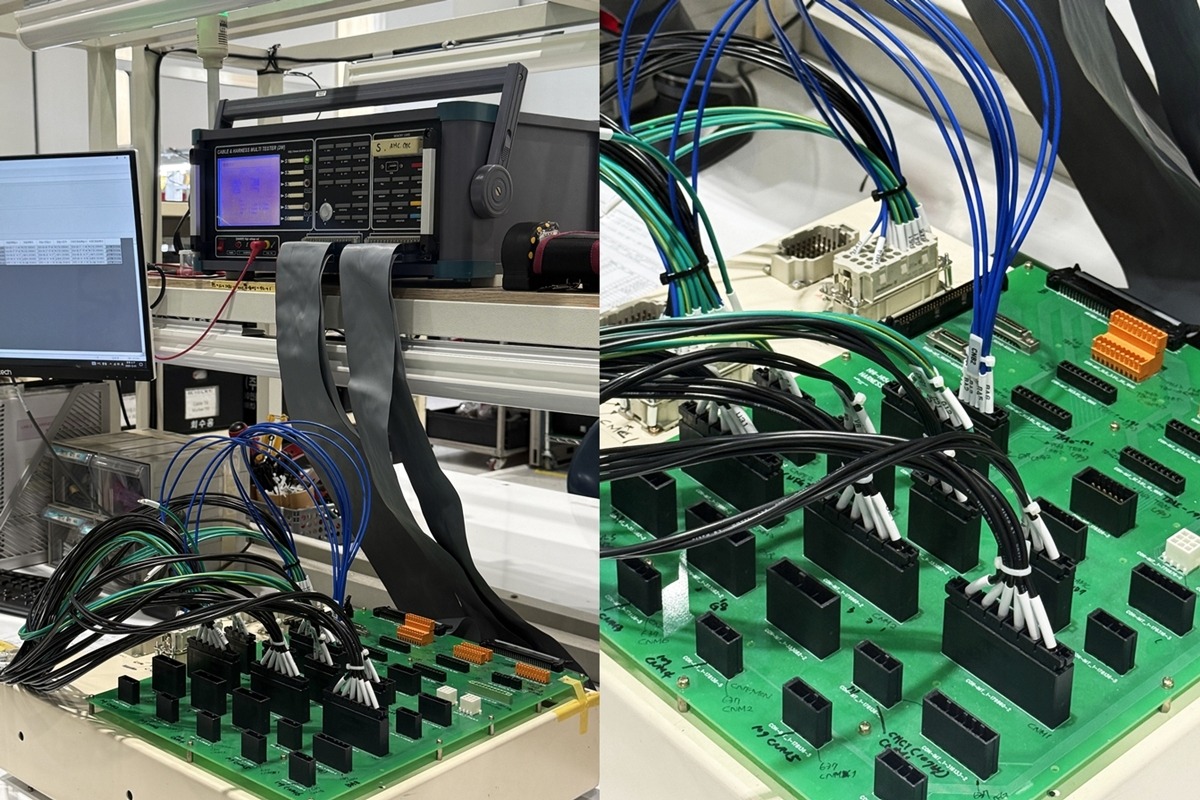
The first test the assembled wire harness encounters is the continuity test. As the name suggests, it is a process that verifies whether the wires are properly connected from end to end without any breaks. Once the connector is engaged with the test jig, the tester sends a minute electric current to check for opens, miswiring, and shorts. When a cheerful “beep” sounds from the continuity test equipment, it means the harness has passed the signal connection check. However, it is too early to relax—the real test comes next.

🚦The Second Test: Withstand Voltage Test

If the continuity test is a process to check whether “the road is connected,” the withstand voltage test is a process to test whether “the walls of that road are strong enough.” In this method, a high voltage—several to dozens of times greater than the voltage flowing during actual product operation—is applied intensely and instantaneously between the wire and the insulator. If there is an invisible, microscopic scratch on the insulation or if the insulation state is unstable, it cannot withstand this high voltage, creating an electrical spark that causes the tester to issue a failure notice.

The withstand voltage test is the final stage that proves the safety of the harness.

KakaoTalk 20260410 094056213 scaled

🚦And Insulation & Resistance Test

The insulation resistance test that follows precisely measures whether the resistance value of the insulator, through which electricity should not flow, is sufficiently higher than the standard threshold. This is to completely detect in advance any leakage current—a phenomenon where minute amounts of electricity leak to adjacent wires due to microscopic moisture, invisible dust, or scratches on the insulation.
KakaoTalk 20260410 094056213 03 scaled

An Uncompromising Pursuit of Perfection: The Wire Harness

Only wire harnesses that have successfully passed both the continuity test and withstand voltage test are finally labeled, packaged, and shipped to our clients. To the untrained eye, it may look like nothing more than a bundle of wires tightly wrapped in vinyl tape and tubing. However, inside lies the precision that tolerates not even a single strand of error, along with rigorous quality standards that prioritize user safety above all else.

If you are considering custom wire harness production, contact BK HARNESS. 📞


https://www.youtube.com/@Bkharness
https://blog.naver.com/bkharness
Youtube
Naver Blog