

05 03 “Three Key Specifications for High-Voltage Wiring Harnesses


│ Three Key Specifications for High-Voltage Wiring Harnesses
From Energy Storage Systems (ESS) and high-output industrial robots to smart grids, high-voltage wiring harnesses have evolved beyond mere bundles of wire into critical infrastructure that determines system survival. As the high-voltage era accelerates with the introduction of ultra-fast charging systems reaching the $800\text{V}$ class, the design paradigm for wiring harnesses is now being restructured around three core pillars: thermal management, insulation, and absolute safety.
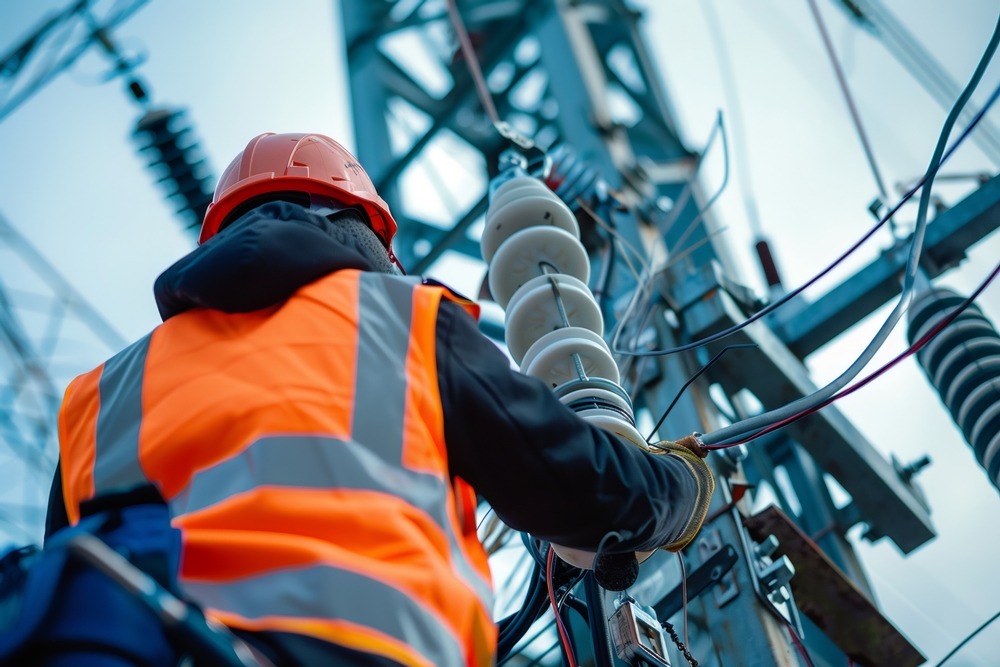
🔶 Heat: The Core Specification of High-Voltage Harnesses
As electronic devices deliver higher performance, cables must carry significantly greater currents. According to the laws of physics, the flow of electric current inevitably generates heat. This goes beyond the simple issue of components getting hot; it leads to a degradation of overall system efficiency and poses a severe fire hazard.
Consequently, thermal management stands as the most challenging obstacle in high-voltage wiring harness design. The core of thermal management lies in minimizing resistance ($R$) and optimizing the heat dissipation structure. The amount of heat generated by a conductor adheres to Joule’s Law, as shown below:

Since $I$ represents current here, even a slight increase in current causes the generated heat ($Q$) to escalate sharply in proportion to its square ($Q \propto I^2$). To resolve this issue, modern harness design must focus on striking a balance between lightweighting and heat dissipation performance—not simply by making the wires thicker, but by utilizing high-heat-resistant insulation materials or introducing aluminum conductors.
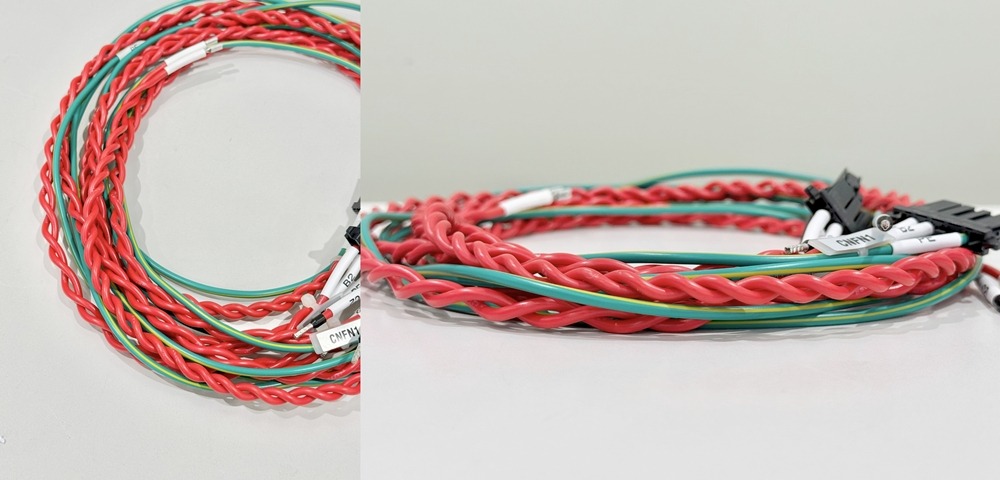
🔶 Insulation: The Core Specification of High-Voltage Harnesses
In low-voltage environments, insulation was merely a protective jacket designed to prevent electricity from leaking out. However, in the high-voltage era—where hundreds or thousands of volts surge through systems—insulation demands an entirely different level of technological sophistication. This is because higher voltages cause electricity to trigger arcing phenomena, where current attempts to puncture the insulator and leap through the air.
Achieving flawless insulation requires maintaining the dielectric strength of the material. The critical challenge lies in designing an insulation layer that will not experience even microscopic breakdown, even when subjected to harsh environments such as external moisture, temperature fluctuations, and chemical corrosion. Rather than simply viewing this as “trapping electricity,” advanced engineering must adopt specialty materials like Cross-linked Polyethylene (XLPE) or silicone rubber to maintain insulation performance without forming microscopic cracks.
🔶 Safety: The Core Specification of High-Voltage Harnesses
A powerful electromagnetic field is formed around cables carrying high-voltage currents. This electromagnetic field acts as the primary culprit behind Electromagnetic Interference (EMI), which distorts signals or triggers malfunctions in nearby precision instruments. Consequently, safety in high-voltage wiring harnesses is directly linked to “shielding” technology.
It is essential to implement technologies that wrap the cable harness in braided layers or foils made of copper or aluminum to prevent internal electromagnetic energy from leaking outward. Furthermore, a physical interlock with circuit protection systems—which immediately cuts off power in the event of a physical impact or wire breakage—serves as the ultimate fail-safe for high-voltage systems to coexist safely with humans.
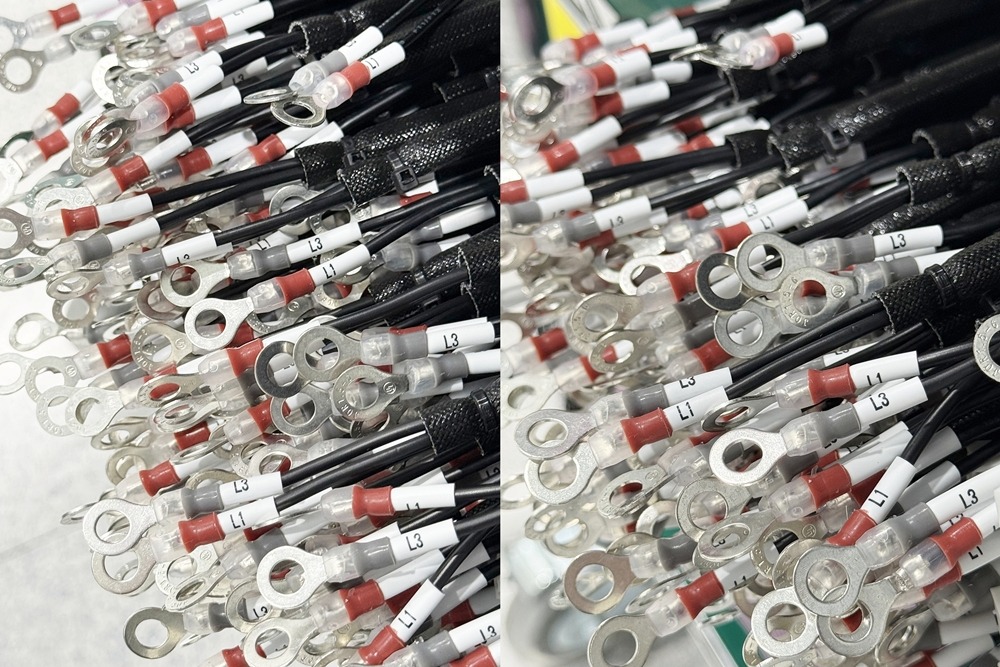
│ In the high-voltage era, wiring harnesses are no longer mere commodities.
A high-voltage harness is a highly engineered product that safely contains energy (insulation), regulates generated heat (thermal), and blocks unwanted interference from the external environment (safety). This technological reliability—which controls massive amounts of energy flowing unseen—will serve as the solid root sustaining the future high-output industrial ecosystem. Ultimately, the harmonious synergy among these three pillars—thermal management, insulation, and safety—stands as the definitive metric determining both product performance and system safety.