

08 05 Insulation crimp flaw and tensile strength in cable harnesses
“Cable Harnesses
: How Does Insulation Crimp Flaw Affect Tensile Strength?”
Today, I’d like to discuss , a representative type of crimping defect that frequently occurs in cable harness manufacturing and quality control. Although easily overlooked during terminal crimping due to its subtle appearance, it is a primary culprit that drastically reduces the product’s tensile strength (the pulling force the wire can withstand). To make it easy for beginners to understand, I will explain how an insulation crimp flaw affects tensile strength and why.
In proper terminal crimping, the core crimp area—which tightly grips only the copper core strands—and the insulation crimp area—which grips the outer jacket—are strictly separated. However, if the wire stripping length is too short or the wire is pushed too deep during operation, the insulation gets forced into the area designated for crimping the core strands and gets crimped together. This phenomenon is known as an ‘insulation crimp flaw’.
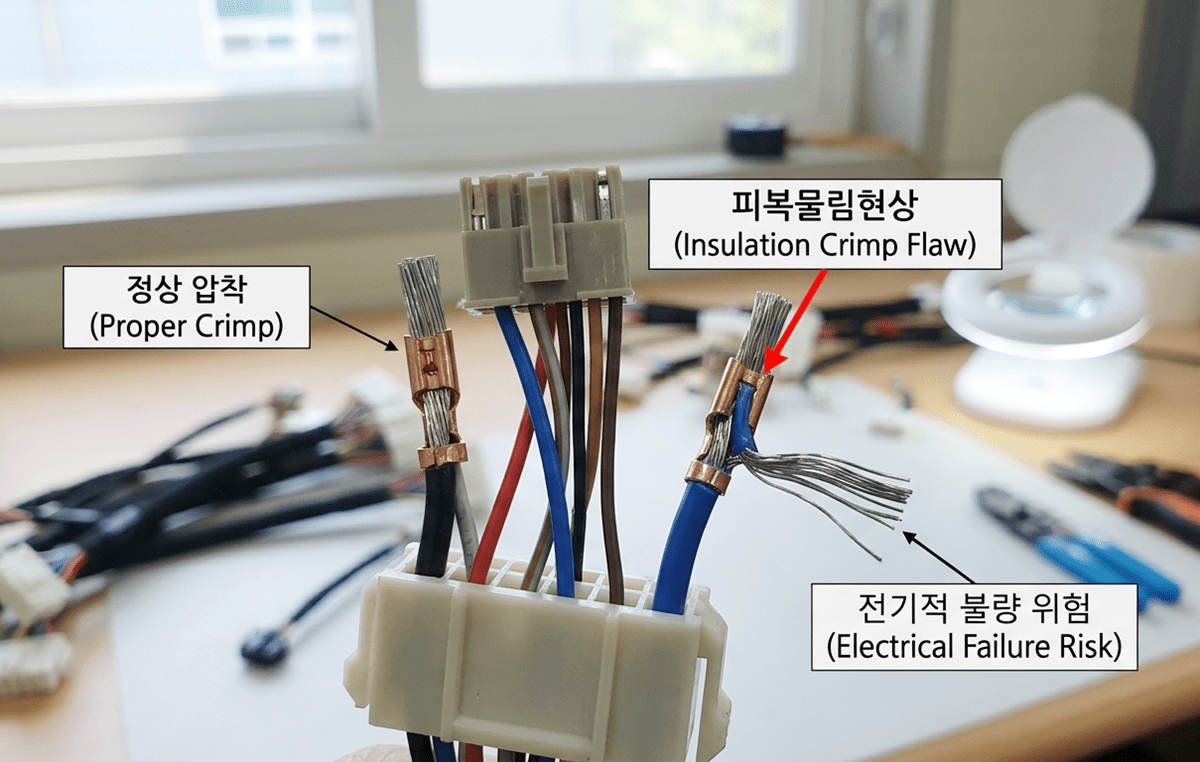
✔️ Why Insulation Crimp Flaws Slash Tensile Strength: 3 Key Reasons
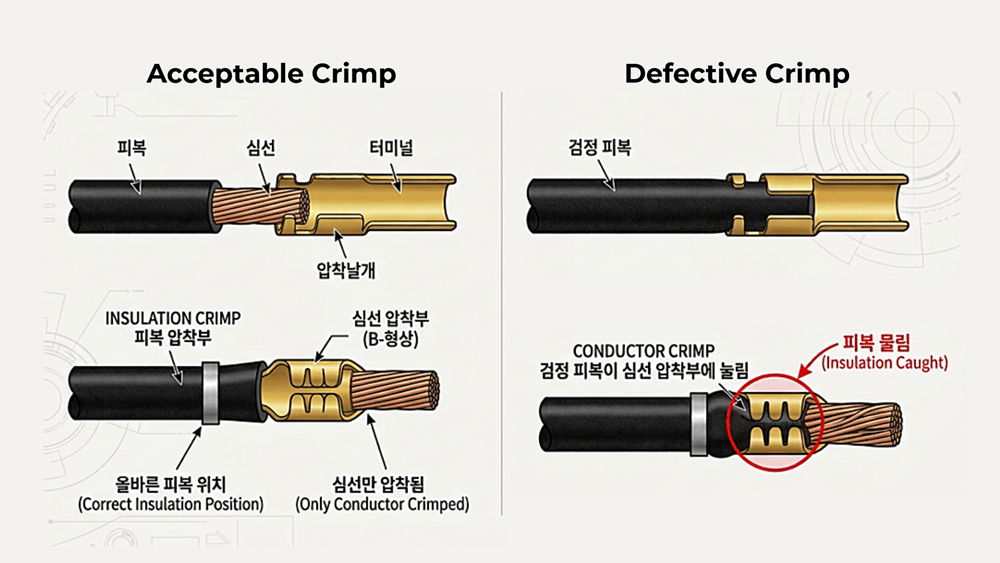
When an insulation crimp flaw occurs in a cable harness, the pulling force it can withstand (tensile strength) becomes extremely weak. The core reasons are as follows:
① Interference with Contact Between the Metal Terminal and Core Strands
👉🏻 The copper core strands and the metal terminal must be tightly mated without gaps to create a solid grip. However, the insertion of soft and slippery insulation material prevents the metal terminal from tightly crimping the core strands.
② Easily Pulled Out Even Under Low Tensile Force
👉🏻Insulation made of PVC or rubber is elastic and has a slippery surface. As a result, even minor vibrations during equipment operation or a slight pull during handling can easily cause the wire to slip out of the terminal.
③ Reduction in Effective Contact Area
👉🏻 As the insulation occupies space in the core crimp area, the amount of copper core strand that securely bonds with the terminal is reduced. In other words, the area of copper wire meant to absorb the force becomes insufficient, making it break or pull out easily even under light tension.
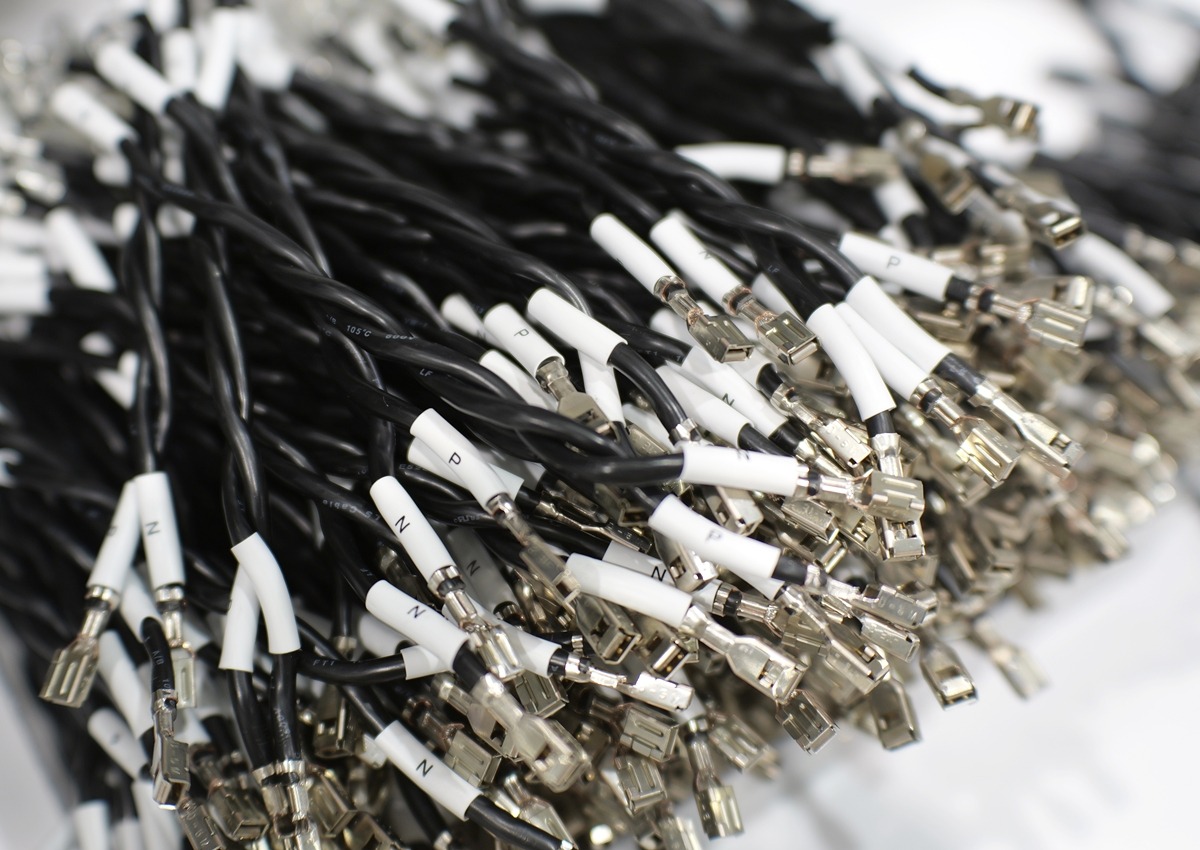
An insulation crimp flaw does not simply end with the wire pulling out easily; it can also lead to increased contact resistance and heat generation. As the contact area between the conductive copper wire and the terminal decreases, resistance rises, causing heat to build up when current flows. The heat generated in this way can melt the insulation, cause disconnections, or create sparks, potentially leading to severe fires or equipment failure.
An insulation crimp flaw also causes major issues during the continuity test, an essential inspection step in the harness assembly process.
💠 Complete Insulation (No Electrical Continuity)
: If the insulation—a non-conductive material—completely blocks the gap between the copper core strands and the metal terminal, current cannot flow at all, resulting in a failure during the continuity test.
💠 Increased Contact Resistance and False Pass
: Even if only a portion of the core strands barely touches the terminal and narrowly passes the continuity tester, it can cause intermittent disconnections—where electrical signals drop out under light vibrations or current loads once installed in actual equipment.
Along with the continuity test, when looking at the crimp height measurement method used to check for insulation crimp flaws, the key principle is that crimping should not merely be “tight.” Instead, it must achieve an optimal compression rate where voids within the copper core strands disappear, fusing the terminal and core strands tightly as if they were a single piece of metal. To ensure cable harness quality, maintaining precise stripping lengths during assembly, along with crimp height measurements and periodic tensile strength tests, is paramount to preventing insulation crimp flaws.